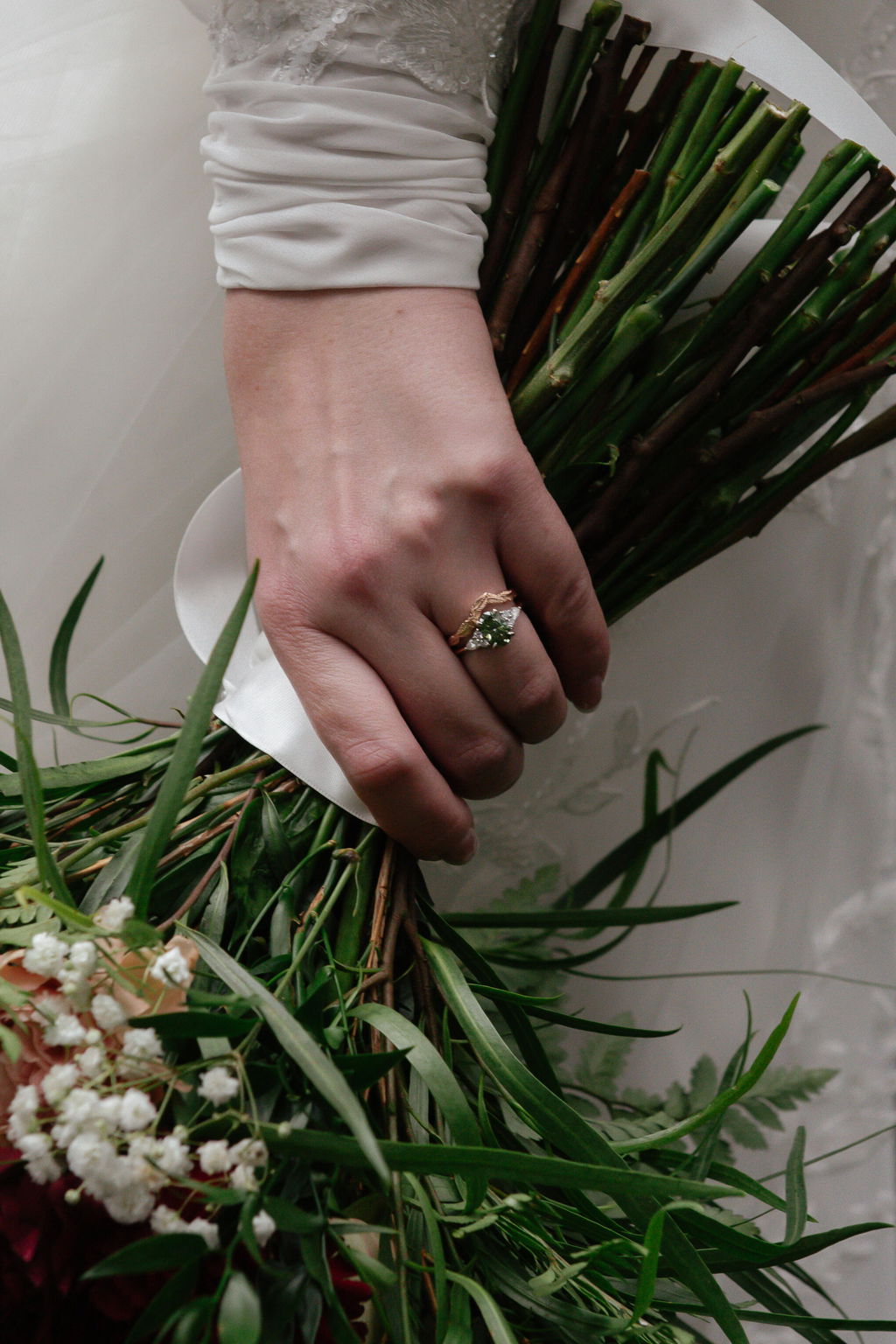


Many of us are becoming ever more concerned about the environment. We’re actively looking for ways to reduce our carbon footprint, limit our impact on the ecosystem and seek out companies that are both sustainable and ethical.
As a result of this, an increasing number of people are choosing to buy an ethical and sustainable engagement ring to fit in with their values.
Key Takeaways
- Ethical means low impact: a ring that creates a low impact on the environment and doesn’t violate human rights.
- Stones: look for conflict-free or lab-grown stones, and combine them with recycled metals.
- Made in Perth: we manufacture all our jewellery in our studio workshop in Western Australia.
- Recycled gold: we use recycled gold in our rings.
- Trees: 5 trees are planted with every order, through onetreeplanted.org.
What makes an engagement ring ethical?
Diamonds are the most popular gemstones for engagement rings. However, the demand for these gemstones has led to a number of environmental and humanitarian crises around the globe.
There are a whole host of problems associated with mining diamonds.
- The ecosystem: severe damage where the diamond quarries are located.
- The workers: the exploitation of the mine workers who work in them.
- Conflict: diamonds being used to fund weapons for wars and conflicts around the world.
Fortunately, many alternative gemstones exist that are equally as stunning as diamonds but obtainable without the associated environmental and human costs. So, what makes an engagement ring ethical?
Ethical engagement rings are rings that create a low impact on the environment, and don’t violate human rights. When choosing an ethical engagement ring, look for conflict-free or lab-grown diamonds and gemstones and combine them with recycled metals for the ultimate in sustainability.
Ethical Stone Options Compared
This table shows how the main stone choices compare on the points that matter for an ethical ring.
| Stone | Where it comes from | Ethical points |
|---|---|---|
| Mined diamond | Quarries around the globe | Linked to ecosystem damage, worker exploitation and conflict, unless sourced from conflict-free suppliers |
| Lab-grown diamond | Made in a lab | Obtainable without the associated environmental and human costs of mining |
| Moissanite | Made from silicon carbide crystals, recreated in the lab | An excellent choice if you prefer not to have mined diamonds |
| Other gemstones | Aquamarine, Smokey Topaz, Alexandrite and Moss Agate | Equally as stunning as diamonds, with a different look |
Choosing an ethical engagement ring from Vinny & Charles
At Vinny & Charles, we place a high emphasis on ensuring that our engagement rings are both ethical and sustainable. We manufacture all our jewellery in our studio workshop in Perth, Western Australia so that we have full control over the manufacturing process.
All our pieces are crafted with love and the utmost attention to ensure that they’re of the highest quality and that they will stand the test of time. We want your engagement ring to become an heirloom that will be passed down from generation to generation.
- Full control: every piece is made in our own workshop, so we oversee each step of the manufacturing process.
- Built to last: rings made to stand the test of time and become heirlooms.
- Recycled metal: we use recycled gold across the jewellery we make.
- Conflict-free sourcing: diamonds come from sources that follow the Kimberley Process.
To ensure that our rings are both sustainable and ethical, we use recycled gold and source our diamonds through highly reputable and conflict-free sources that follow the Kimberley Process (KP). The Kimberley Process is a commitment to remove conflict diamonds from the global supply chains.
You can read more about how we work on our Our Ethos page, and in our guide to recycled gold.
Moissanite and Lab-Grown Stones
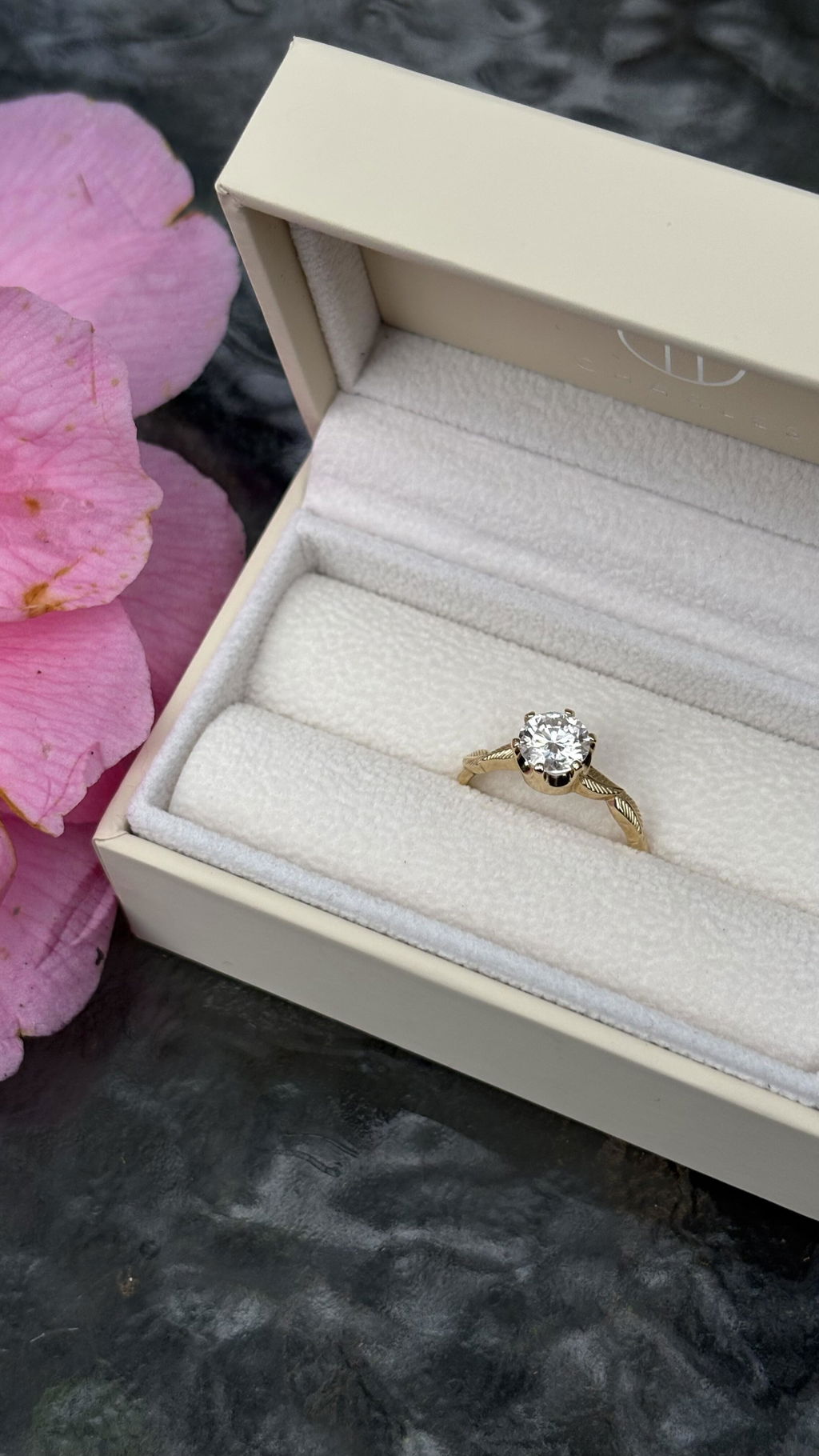
We also utilise lab-grown stones such as Moissanite in our designs. Henri Moissan, a French scientist, discovered natural moissanite in 1893 in a meteorite crater in Arizona. Made from silicon carbide crystals, natural Moissanite is extremely rare, but it can be successfully recreated in the lab.
While a lab grown Moissanite may look like a diamond, its composition, durability, brilliance and colour are distinctly different. But it is a truly beautiful stone nonetheless and an excellent choice if you prefer not to have mined diamonds in your engagement ring.
- Brand: we use Charles & Colvard® Moissanite.
- Certification: we provide certification for any stone over 0.50ct.
- Warranty: Charles & Colvard® also provide a limited lifetime warranty on their gemstones.
- Hallmarked: whether we use natural or lab-grown gemstones, each piece is fully hallmarked.
Whether we use natural or lab-grown gemstones, or other gemstones such as Aquamarine, Smokey Topaz, Alexandrite or Moss Agate, we make all our pieces in line with industry standards.
Questions to Ask Any Jeweller About Ethical Rings
If you want to buy an ethical engagement ring, these questions help you compare jewellers on the same points.
- Where is it made? Ask where the ring is manufactured and who controls the process.
- What is the metal? Ask if the gold is recycled.
- Where does the stone come from? Ask if it is conflict-free, lab-grown or mined.
- Is it certified? Ask what certification comes with the stone.
- Is it hallmarked? Ask if the piece is made in line with industry standards.
Giving back to nature with every ring
All the designs at Vinny & Charles are inspired by nature. But our commitment to the environment goes much further than that. For every order we receive, we give back to nature by planting 5 trees through our collaboration with onetreeplanted.org.
So, when you buy your engagement ring through us you are not just choosing an ethical engagement ring, but you are choosing a sustainable engagement ring that has been inspired by nature, created with care and consideration, and delivered with passion and love.
Frequently Asked Questions
What makes an engagement ring ethical?
An ethical engagement ring creates a low impact on the environment and doesn’t violate human rights. Look for conflict-free or lab-grown gemstones, and combine them with recycled metals for the ultimate in sustainability. Ask the jeweller where the ring is made.
Are lab-grown diamonds ethical?
Lab-grown stones are obtainable without the environmental and human costs associated with mining diamonds. That makes them a popular choice if you prefer not to have mined diamonds in your engagement ring. See our collection of lab diamond engagement rings for options.
Is moissanite an ethical choice?
Moissanite is made from silicon carbide crystals. Natural moissanite is extremely rare, but it can be successfully recreated in the lab. Lab grown moissanite is an excellent choice if you prefer not to have mined diamonds. We use Charles & Colvard® Moissanite.
Do you use recycled gold?
Yes, we use recycled gold in our rings. Every ring is handcrafted by us in our studio workshop in Perth, Western Australia, so we have full control over the manufacturing process. You can read more about our approach on our Our Ethos page.
How many trees do you plant?
We plant 5 trees with every order, through our collaboration with onetreeplanted.org. All the designs at Vinny & Charles are inspired by nature, so giving back to nature is part of how we work, on every single ring we make and every order we ship.
Shop Ethical Engagement Rings
Ready to see an ethical ring in person? Browse our engagement rings and buy online with free express shipping.
Questions about how we make our rings? Call us on +61 8 6323 8494 or email info@vinnyandcharles.com and we will talk you through it.